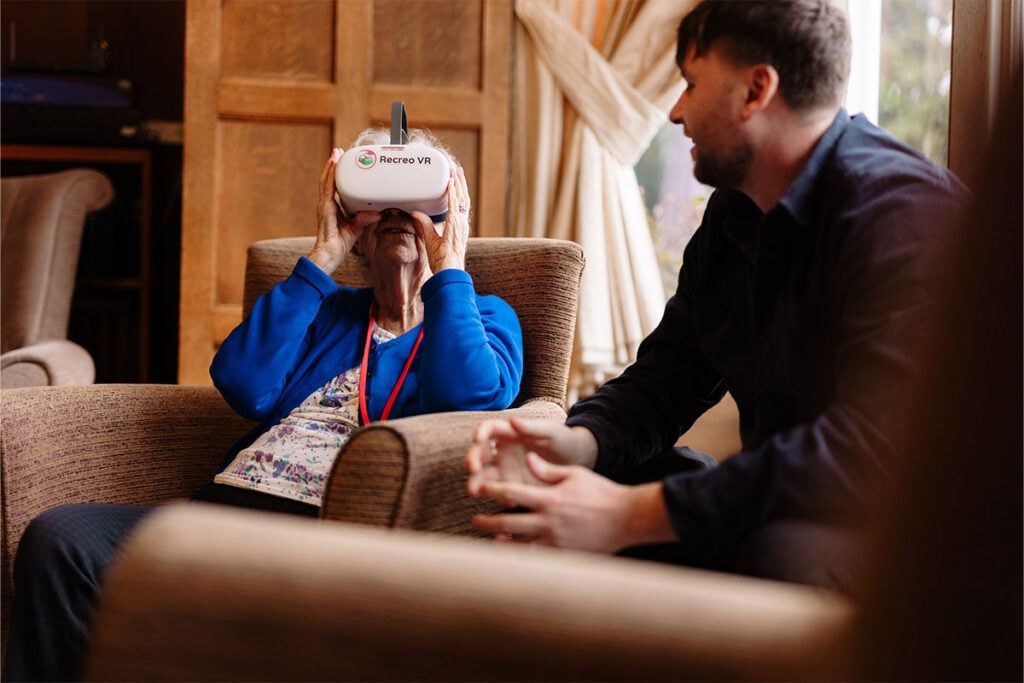



While technology has the potential to support the dementia population as a whole, and across care settings, a focus on the individual is critical to realising full benefits – as one VR solution has demonstrated. Claire Read reports.
Sam Rooker was deep in the design process for his virtual reality care solution when he had a course-altering conversation with a potential user.
“I sat down with a lady in her late 80s, in Yorkshire,” says Rooker, Director of Recreo VR.”I said to her: ‘You can go anywhere in the world with this technology. Where would you like to go?'”
Would she perhaps speak of wanting to instantly travel the 5,000 miles that would take her to India’s Taj Mahal? Maybe she’d want to go to the other side of the world for a trip to the Sydney Opera House? How about a journey to the Seine and a glorious view of the Eiffel Tower?
No, none of those. Her response was that she wanted to journey to a location far closer to home: Scarborough.
“It was just 20 minutes down the road from where we were,” recalls Rooker. “But that’s where she’d spent a lot of her life, and the most important place to her.”
It presented Rooker and his Co-Founder Alex Lancaster with a task they’d not necessarily anticipated. Their idea had been to create a VR content sharing app designed for care settings, with particular relevance for dementia, and largely focused on pre-existing content. But with the Scarborough conversation, it became clear that they needed footage that didn’t currently exist.
“Nobody was making 360 degree content of those sort of places,” says Rooker. “So we realised early on that not only would we have to provide a VR content sharing app, but we would have to basically create a lot of the content.”
Bringing familiar places back to life
Today, 150 care organisations across the country are using Recreo VR, including large care home groups and local authorities who use it to help people living with dementia. And while the solution allows trips to locations as exotic as the pyramids of Egypt, or a safari to see elephants, a huge proportion of the content has been designed to “give people access to the places that meant the most to them.”
“One of the things that we hit on early doors was that person centred content is the key,” explains Rooker. That doesn’t only include the places that people once called home, but also the likes of previous work environments and hobby settings.
A feasibility evaluation, co-designed with the Alzheimer’s Society and published last year with the University of Leeds, suggests that this sort of tailored approach is a highly impactful one. The study included 101 people living with dementia, 50 of whom who were in care homes, and 51 who were receiving community services.
The study found that virtual environments rekindled memories tied to specific places, with participants recognising farms, holiday destinations, and coastal walks from decades earlier. A VR scene set on a working farm, meanwhile, helped one person remember their own farm from decades earlier, and led to conversations about livestock and long-forgotten daily routines.
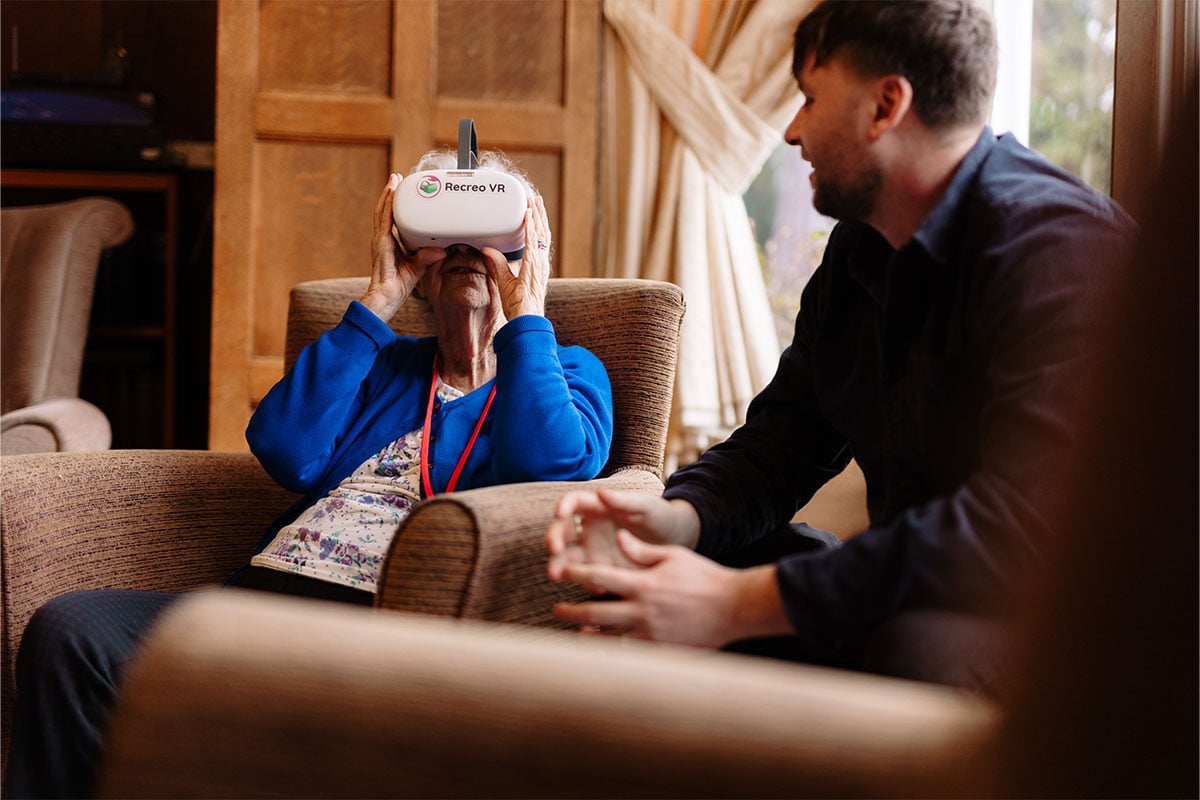
“We’ve seen [the solution] has a direct impact on memory recall,” says Rooker. “We’ve found that by just putting the headset on somebody – taking them away from a busy lounge with lots of noises and people, and a high stimulus environment – it gives people that opportunity to breathe and be somewhere by themselves. And if that place is meaningful and engaging, we’ve found that it directly impacts mental and social wellbeing.”
It can also be helpful in reducing agitation and distress in those with dementia, says Rooker, and it’s here that personalised content is particularly important. “We’ve had numerous examples of people who want to go home and can’t go home, and that level of agitation often takes a couple of members of staff quite a lot of time to [address], potentially also going down the route of medication,” he says.
“What we’ve done for individuals is record their hometown and then use that as a way of saying: ‘Well we obviously can’t go home, but see if you recognise this.’ And it takes one member of staff three minutes to completely change that person’s outlook. As a distraction it works really well.”
The fact that the technology is swift and simple to use is intentional, Rooker says. The content sharing app is designed to be intuitive for staff, but there are also no barriers to use for the care home residents themselves. They simply pop on a headset and they’re immediately sent into the VR experience that has been loaded for them by care staff – there are no controllers they need to use. And because the content is deliberately stationary and filmed at seated height, the risk of the sort of motion sickness that can be associated with VR is minimised.
Starting with the person, not the technology
That sort of focus on user need is likely to characterise the tech with the greatest potential to make a difference in dementia. In an era of fast moving developments, and continued and deepening pressures in care, there is a natural inclination to assume that every new technological capability can be usefully applied. But many stress a need for caution, seeing the risks of being seduced by something that might look shiny but has no practical application. Essentially: just because you can do something apparently clever with technology doesn’t mean you should.
As Chief Executive of community interest company Care City, a firm seeking to design better health and care systems, Matt Skinner says he sometimes sees caretech solutions which are in search of a problem.
“There is so many of these kind of technologies that are coming into the market, which are really interesting and it’s moving at such a pace, but I also know that a lot of the time, the underlying need is missed,” he says. “We get technologists who come to us saying: ‘Oh, we’ve developed this thing, can you help us to test it?’ And I’ll say: ‘Well, have you spoken to anybody about what the problem is that they’re experiencing and how your thing might solve a real life problem?'”
The response, he says, is often no. And that’s an issue; one which will affect the ability of care settings to find the technology that makes a difference. Skinner continues: “I sometimes feel like there’s a lot of pressure around making the argument that we need to like adopt technology and roll it out. And we’re missing the really important question, which is: “Who’s the person at the centre of this? And how are we making sure that we’re designing a thing that actually makes their life better rather than worse?
“There’s definitely a business case in technology for the public sector, but we need to make sure that what we’re designing meets an actual need and fits into somebody’s life. The best tech that we’ve seen is the stuff that is built around people’s lives.”
Designing technology around real needs
It’s a point also made by Victoria Lyons, a dementia specialist Admiral Nurse for two decades and Head of digital clinical transformation at Dementia UK. Her role at the charity involves exploring how digital tech can help develop and deliver services that make a difference to people. And in considering that, she says it’s always necessary to start with user need.
“Whenever I think about tech [and how it can be used to make a difference], it’s starting with the person and a problem that can be fixed – especially these days with the changes in AI and the way that we can all code and do all sorts of things, and we’ve got all sorts of wearables that are all around us all the time.
“Technology is really valuable. It can improve people’s lives. But it can affect them in a negative way too. This is the reality,” concludes Lyons. “So with whatever it is that is being developed, you have to start with a tool that is actually meeting a person where they are or is fixing a problem.” And that might mean meeting in Scarborough.
Please stay tuned for the next installment of this series on dementia care
For more caretech news, check out the other articles on the website, and for more information please email us at roshini.bains@starmediaservices.co.uk