

For many of us, a delivery is a regular occurrence. It is not a major event. The doorbell rings. We answer it if we’re home. We sign for anything that needs to be signed for. We take in the parcel. But for someone with limited mobility, anxiety about opening the door to strangers, or a day that’s filled with appointments and routines, that small, innocuous moment can become an anxiety trigger, or a missed delivery can lead to consequences, such as missed medication.
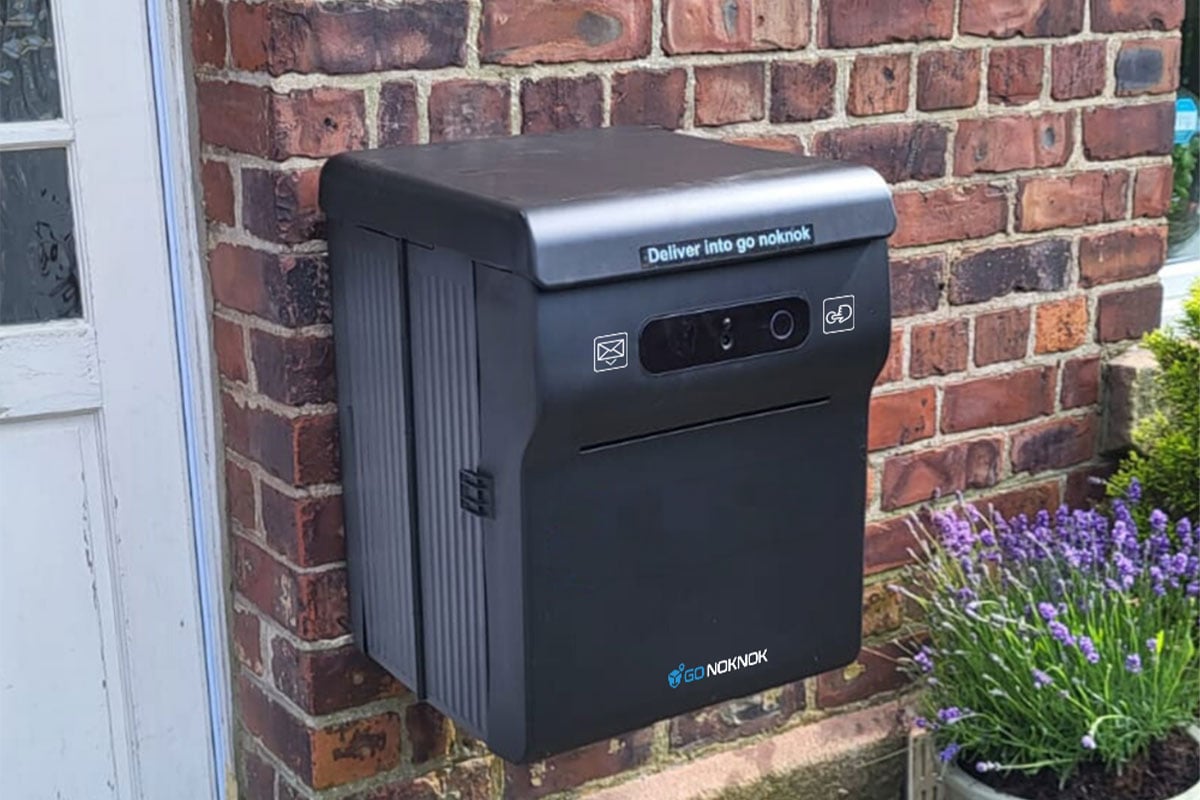
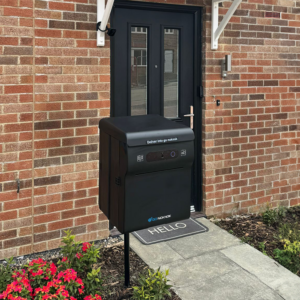
GO NOKNOK is a Newcastle-founded smart parcel box company that is solving that everyday challenge. Its mission, says Rez Gachcar, Founder and CEO, is to provide “front door infrastructure for independent living”.
The idea behind GO NOKNOK
The idea began in 2021 Gachcar, an entrepreneur and inventor who also founded the British dog-care brand Mud Daddy. “My work has always centred on identifying everyday problems and creating practical products and services that make people’s and dogs’ lives easier,” he says.
When GO NOKNOK was conceived, Gachcar pondered: “Why do we still need to be physically at home to manage a delivery when we can manage so much else remotely?”
Development began in 2022, and there was a soft launch in October 2023.

The product is a smart parcel box that lets people receive, send, and return deliveries through an app. If a courier needs to collect an item, it can be arranged via the app much the same way it works for deliveries. But it wasn’t until people started using it that its wider appeal became clear. “For someone with limited mobility, getting to the door can be difficult, stressful, or sometimes impossible. Being able to receive groceries, prescriptions, and everyday essentials without rushing to the door can give that person greater control over their day.”
Today, there are more than 3,200 units installed across the UK, and Gachcar estimates that around 80% serve older people or people with disabilities. He adds that this doesn’t mean they are care home installations, as many customers live independently in their own homes.
How it works
There are currently two models, and each is designed for different things.
The Expandable is a composite-material box for individual homes, and it is fixed to the wall or attached to a pole. It flattens when not in use, sitting out only 20 centimetres when flattened, and expands to 40 centimetres when a parcel arrives, which suits properties with little frontage. The Expandable weighs 7kg and takes loads up to 25kg. Its lid locks and unlocks, and residents have several ways of managing access:
- Scheduled unlock: a resident whose courier arrives at the same time each day can set a window during which the box unlocks. It then locks again once a parcel is inside or the window ends
- Email syncing: the box can connect to the user’s email account to read delivery notifications. AI in the system checks the sender’s domain, the subject line, and the email’s contents to avoid picking up spam, then lists the day’s expected deliveries in the app, and it remotely unlocks and locks deliveries during the scheduled delivery period – with the box automatically locking after delivery has been made
- Manual unlock: if a courier turns up outside the window, they can press a button on the device, which alerts the resident’s phone. Once the resident presses unlock, the box opens and asks the courier to place the parcel inside
The Drop is a metal, floor-standing model designed to be shared by around five users, so it suits supported housing and shared buildings. It needs no unlocking for the courier at all. The courier lifts the lid and places the parcel on the platform, and when the lid closes, it sends the package into a lower, locked chamber. Residents collect parcels via the app or with a manual backup key. The bottom of the chamber is lined to cushion parcels as they drop in, and the mechanism means that once the parcel has dropped into the lower chamber, anyone lifting the lid again cannot reach it.
Both models are waterproof and have a built-in security alarm that sounds and speaks aloud if someone tampers with the box.
What makes this different from a key safe or a video doorbell?
Harriet Taylor, Business Development, Partnership, and Marketing Manager at GO NOKNOK, came to the sector through a managed IT company whose clients included home-care franchises, helping each new brand set up its infrastructure. She says it is the nature of the work, enabling real change to people’s lives, that keeps her passionate about the sector. “You’re truly helping people and really solving a problem. That [is] such a rewarding thing.”
When talking about what sets the company apart from other pieces of assistive home tech, Taylor says that there is not a
wide range of technology that is available for outside the home. A key safe is designed to allow family and friends to enter a premises during an emergency, and “you don’t want anyone and everyone having access to that.” A video doorbell, meanwhile, is “great, but it’s just two-way communication. It doesn’t do more than that.”
To illustrate the gap that GO NOKNOK is filling, Taylor gives an example of a customer who uses a wheelchair and has a lift in their home. “The doorbell goes, they’re upstairs. That’s going to take a good amount of time for them to get to the front door. And nine times out of 10, by the time they’ve got there, the delivery has gone.” When the parcel is medication that needs to be signed for or kept cool, a returned delivery can have serious consequences if, for example, that person has run out of their medication supply and a courier has to take it back to the depot, and the recipient won’t receive that parcel until the next day at the earliest.
“We don’t want people having to rely on other people to receive their everyday deliveries. We want people not to be excluded because they can’t get to the door quickly, because they have anxiety around people opening the door to strangers, or because they have a routine that they need to stick to,” she says.
Medication and time-sensitive items
When it comes to receiving time-sensitive items, such as medication or food, the Expandable model includes a cool and heat bag which, Taylor says, keeps items cold for up to two hours or warm for up to one hour. That time can matter greatly to someone who uses a wheelchair: “If they’ve got a food delivery, it gives them that extra few minutes to get to the door.”
Once a courier delivers any time-sensitive items into the delivery box, that item becomes the responsibility of the resident or support worker. That extra time can be particularly useful in supported living, where floating support staff move between residents as needed. “They know, ‘I’ve got two hours until I need to sort that medication out’, rather than ‘Oh my goodness, it’s sat on the doorstep. I need to get there now’.”
Privacy, security, and consent
As the boxes include a camera, questions around privacy are inevitably raised. Gachcar says the camera records delivery or collection activity while it takes place, and “does not continuously record residents or their daily activities.” Recordings are held in Amazon Web Services Cloud infrastructure for 30 days, and access is limited to the account administrator and anyone they have added. The camera has infrared for night vision and has live audio and visual streaming as well as motion detection capabilities. Up to five additional people can be added to an account, such as a family member or a partner, and users manage access and delete recordings through the app.
GO NOKNOK has also completed CASA (Cloud Application Security Assessment) Tier 2 verification, which is an application security assessment, and Gachcar says the company can supply documentation detailing the scope of the assessment.
Consent, however, is more complicated where a resident lacks capacity. Gachcar says arrangements for authorising use and managing account access “need to be agreed with the responsible care or housing organisation and the person legally authorised to act for the resident.” Taylor says that in practice, some people with dementia do not operate the box themselves; family members manage it, so that a parcel sent to a relative is, for example, “already waiting at mum’s” when they arrive.
Installation and limitations
GO NOKNOK handles installation for care organisations. The team asks for photographs of the proposed location first, then carries out final checks on site. Taylor says they have yet to attend a property where installation was not possible. Where wall fixing is not an option, a pole concreted into the ground is available.
Taylor acknowledges that the product still has limits for some groups of people. It relies on a smartphone and a Wi-Fi connection at the property, which not everyone has. “I’m sure in 10 or 20 years we’ll see the whole older generation having smartphones, but we’re still not quite there yet.”
What is next?
The company is at an early stage in its work with housing and care providers, and is working with Karbon Homes, a company based in the North of the UK who build, manage, and look after homes for people, to support residents with additional needs. Whilst there are not yet figures on what missed deliveries cost residents or staff in money or time due to the company still being young, it expects to share more about this in the future. However, there is a ripple effect from a parcel being delivered reliably: carers are not fielding calls about missing medication, chasing depots, or arranging emergency pharmacy visits.

When it comes to how this affects residents, Taylor says: “The biggest impact that I personally have seen is people not having to change the way they’re doing things. It’s being able to do things in their own way, not having to rely on someone else, not having to have the care worker deal with deliveries, which frees up time for them to be doing other things that have a real impact on someone.”
Gachcar’s five-year ambition is to make GO NOKNOK “a recognised part of independent living provision,” working closely with housing associations, councils, and care providers, and extending into retirement living, supported and student accommodation, and shared residential buildings. Expansion abroad is a longer-term goal. The immediate priority is strengthening the UK offering and building evidence of its benefits. Taylor adds that future development will be shaped by customers, including a possible multi-language app interface.
“Every change we make going forward is based on customer recommendation,” Taylor says.
Gachcar sums up the company’s aim as being able “to give people more control over everyday life, starting at their own front door.”
For more caretech news, check out the other articles on the website, and for more information please email us at roshini.bains@starmediaservices.co.uk