


Ensuring patients remain safe in their rooms is a growing but rarely discussed challenge. A recent study by researchers from the University of Southampton and University of Portsmouth found that across 32 general adult wards, 16% of scheduled vital-sign observations were missed.
In addition, 31.2% of those observed between 8pm and midnight had no further vital-sign observation recorded in the following six hours.
This means that deterioration can be harder to detect during those hours. Factors such as staff availability, competing clinical work, and time-critical activities contributed to a decline in patient monitoring.
The consequences of these hours going unmonitored can range from longer exposure to undiagnosed infections and falls to a decline in residents’ wellbeing, especially those suffering with dementia.
Ally Cares’ co-founder and CEO, Thomas Tredinnick, believes that their startup’s monitoring technology can help support patient safety.
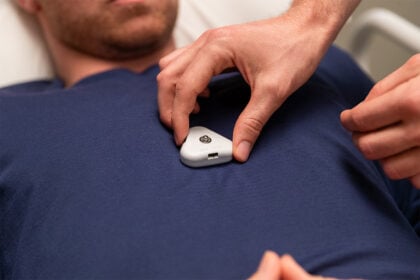
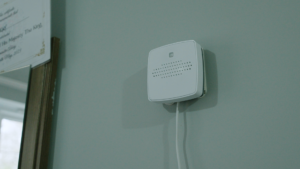
They have developed a small device containing sound and movement sensors that is placed in residents’ bedrooms. The system uses AI and machine learning (ML) to learn residents’ night-time patterns while detecting any deviations.
The device can detect people calling out for help, restlessness, and falls.
Tredinnick says the idea was born out of concerns over problems in the healthcare sector as well as personal experiences with family members in care.
“My co-founder, Zack Mitchell, and I would frequently discuss the problems that exist within care, especially when someone is not around,” he says.
“My grandmother received care in a home and there were huge gaps of time where carers did not go in,” he says.
“She was trying to maintain her privacy and independence whilst needing the chance to recuperate in her room. But there’s a total fear around her needs being missed,” he says.
Tredinnick says his grandmother had very little privacy or independence once in care, while also being susceptible to illnesses.
“She was still having things like falls or chest infections or UTIs that were being missed and picked up late. And it was a really frustrating thing to be able to observe,” he says.
Tredinnick says this experience made him want to create technology that could help understand whether someone needs help immediately or track subtle changes that could lead to serious health issues.
“We wanted the goal to be proactive rather than reactive. Instead of waiting for a chest infection to develop into pneumonia and require a hospital stay, it would be much better to spot the early signs, understand that a cold could develop into something more serious, and intervene prior,” he says.
As engineers, the co-founders identified a lack of insight into patient health during unobserved hours as one of the sector’s biggest challenges.
“The key problem is understanding what’s happening when no one is around to observe those changes,” Tredinnick says.
A breakdown of the technology
The technology is able to differentiate between different sounds because it has a classifier within the product, says Tredinnick.
“We’ve developed an environment and person-centred classifier that’s able to identify a much wider range of sounds and behaviours,” he says.
“It can recognise when someone is vocalising in a way that suggests distress, coughing more frequently, breathing with greater difficulty, or moving around a room based on activity and movement sounds,” he says.
The model segments and categorises those sounds, allowing care staff to decide whether something requires an immediate response or if care needs are beginning to change.
He also says the technology includes passive infrared sensors to help track motion.
Acoustic over cameras
Tredinnick believes acoustic monitoring technologies can offer an alternative to cameras in care homes.
Though cameras can help care providers identify residents at risk of falls, Tredinnick says there are other technologies on the market that have been developed to prevent falls, such as pressure mats.
“The challenge is that not every care need involves movement. Some residents may be bed bound and require assistance, while others may develop respiratory issues, experience side effects from medication changes, or become delirious. Staff need to know about those changes as well,” he says.
Some residents may also experience distress without moving, such as dementia patients, meaning that cameras are less likely to capture those subtleties in the room.
“Care is more personalised to those residents with acoustic monitoring rather than cameras,” he says.